
MATT VOLZ
Editor in Chief
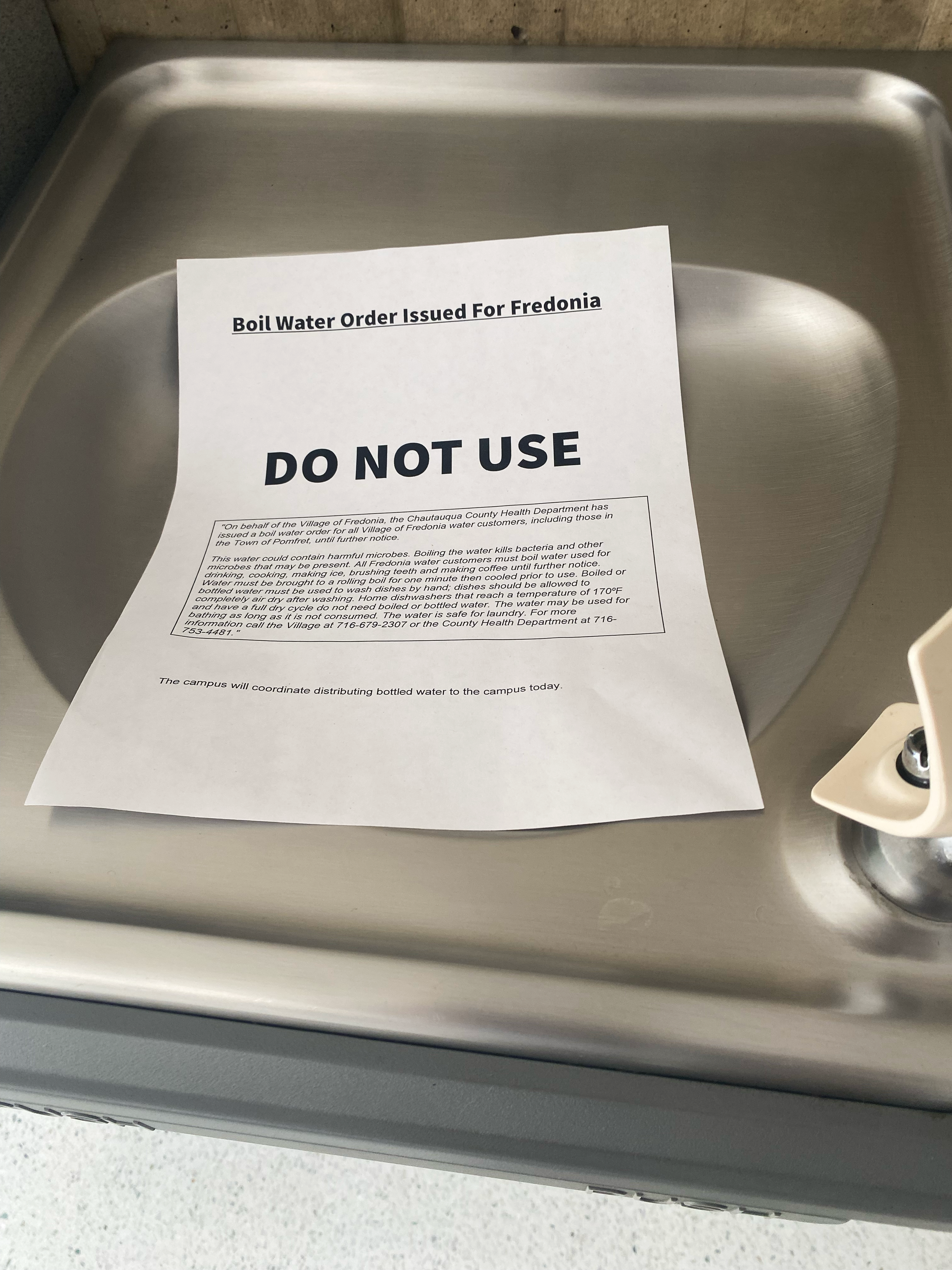
For the seventh time in the last two and a half years, Fredonia’s water isn’t safe to consume.
At 1:10 p.m. on Friday, Sept. 19, students and faculty were notified with an email from Marketing and Communications.
The email explained the precautions taken by FSA, including boiling all water prior to use and providing bottled water to students who live on campus.
It also included the official message from the Chautauqua County Health Department, with instructions on how to safely use the contaminated water.
“On September 19, 2025, the Village of Fredonia received results of two failing bacteria samples in the distribution system; one containing E. coli,” the message said.
Previous boil water orders were caused by issues with the village’s outdated water system, which is nearly a century old.
This one, however, is a bit different, according to Village Mayor Michael Ferguson.
Ferguson said that the contaminated samples came from businesses in the village, which caused the order to be issued.
He said that the tap water was tested at Crosby’s, and the sample came back positive for E. coli.
The tap water was also tested at Culligan, a water treatment company just across the street from the gas station.
The sample from Culligan was also contaminated, but with chloroform.
It’s important to note that the chloroform was not found in water that Culligan distributes, but rather in the building’s personal tap.
The mayor explained that the tests could have tested positive for contaminants due to issues with the individual faucets, so it isn’t a certainty that the water itself is unsafe.
“As soon as you hear E. coli, they shut everything down,” he said. “This is just, unfortunately, the process that we have to go through when something like this happens.”
Ferguson said that further water testing is being conducted Saturday and Sunday, with double testing taking place Saturday.
He said that if the health department finds that Friday’s tests were faulty, they believe they will be able to lift the current boil water order on Sunday.
This issue comes on the heels of a vote on Wednesday, Sept. 10 that will align Fredonia with the North Chautauqua County Water District and end the use of the village’s 97-year-old system.
The North Chautauqua County Water District (NCCWD) is a system of water distribution that treats water from Lake Erie and distributes it to multiple communities.
Dunkirk houses the main water supplier, and Brocton, Portland, Pomfret and Sheridan are all recipients of the water.
There’s been an ongoing debate in the community over whether Fredonia should join the group or not. One of the most prominent and vocal opponents of the deal is “Save Our Reservoir,” a group of Fredonia residents strongly opposed to aligning with the NCCWD and turning away from the reservoir.
Members of the group spoke at last Wednesday’s meeting, a meeting that produced some contentious moments.
During a presentation of analysis by Jessica Wuerstle, director of environmental health services for the Chautauqua County Health Department, members of the crowd shouted in anger at both Wuerstle and the village board on stage.
“We’re going to end the meeting right now if you don’t stop,” said Ferguson.
Ferguson further expressed his discontent by saying to those members of the crowd, “You’ve managed to disrupt another meeting. Congratulations.”
Later in the meeting, Ferguson called out previous village officials for their inaction related to the water issue, some of whom were in the audience.
He claimed that for years, the village government was informed by both the county and state that Fredonia’s water system was not sustainable and needed to be replaced, but nothing was done.
“For 38 years, I have sat here and watched multiple cans kicked down the road,” he said.
Later, he added, “I would ask people in this room who were previously in these chairs, some people for 12 years, what did you do during this time when the government told you that you had a spillway that was too small? When the government told you that your dam was insufficient for what you were doing? You were an elected official sitting in this seat, and you have the gall to come into this room and start blaming these people?”
A woman in the crowd came up to the microphone and expressed her disgust with the NCCWD, but not before accusing Ferguson of sitting on stage “all high and mighty” as well as dredging up the past and blaming others.
Her frustration with the NCCWD lies in the fact that she is taxed by them but does not have a water pipe in front of her home.
“So, screw me, you know you guys are going to get screwed by the hardship of taxes, out of control mouths and minds and lack of heart,” she said.
The woman also acknowledged that she does not live in the village of Fredonia, but it is her community as her friends and family live here.
“There’s all kinds of resources,” she said at the end of her speech. “The water is there in our control. Don’t lose it.”
At the end of the meeting, the trustees voted to approve the plan of receiving water from the NCCWD and decommissioning the 97-year-old facility.
All but one of the trustees voted in favor of the measure, with the only dissenting vote coming from Michelle Twichell, who has been a vocal opponent of joining forces with the NCCWD.
“We only had one ‘no’ vote on switching, and that’s because that particular person feels that we should be revitalizing a 97-year-old reservoir building,” Ferguson said. “The best experts will tell you that the cost would be enormous and there’s no long life for reservoirs.”
Although the new deal is in place and Fredonia is on its way to working with the NCCWD, it’s a shift that will take a few years to fully come to fruition.
Ferguson said he is “99% confident” that once everything is fully settled with the NCCWD, the boil water orders will be a thing of the past.
In the meantime, the village can only continue to do what they’ve already been doing to treat the water. Ferguson said that this process includes sending divers into the tanks to fix the issue and then waiting for the silt that’s been kicked up to come down, which can take “hours, if not days.”
“It’s a very lame thing to say, but it’s the best we can do at this point,” he said. “We’re confident that [the NCCWD] is the way to go.”
Any students with concerns or questions are highly encouraged to reach out to Ferguson or attend a village board meeting.
Meetings are held every other Monday night at 6 p.m. on the second floor of Village Hall.
“The students are as much a resident of the Village of Fredonia as the people who own the homes here,” Ferguson said. “They are owed a fair and honest answer, and I always do my best to do that.”
More information on the current boil water order as well as safe water practices can be found at chautauquacountyny.gov.
Note: This story will be updated in Issue 2 of The Leader, which prints on Tuesday, Sept. 30.