
ALEX BUCKNAM
Managing Editor

Program cuts first came in the Fall 2023 semester, when the school discontinued 13 low-enrolling programs.
Two years later, the recently appointed interim provost is now talking about the potential for more programs to be discontinued.
On Sept. 8, during the campus Senate meeting, it was brought up that more programs will be reviewed for potential elimination.
This was made aware to the majority of students and staff when a campuswide email was sent out on Sept. 12 by the provost’s office.
The email sent out by Interim Provost and Vice President for Academic Affairs, Dr. Judith Horowitz, was titled “Open Sessions for Consultation on Review Process Criteria.”
The email reads, “As announced in the [University] Senate discussion on Monday, Sept. 8, our campus will be reviewing programs for potential discontinuation later this fall.”
The email continued to list dates and times that Horowitz would hold open sessions for students and faculty to share their ideas on what the administration should consider when taking on Fredonia’s multimillion-dollar deficit.
Open sessions were held on Sept. 18 from 9 to 10 a.m. and Sept. 22 from 10:30 to 11:30 a.m. An additional session was held on Sept. 26 from 2 to 3 p.m.
There was also a session on Sept. 25 during the Student Government Association’s (SGA) General Assembly meeting.
The purpose of these open sessions was for the administration to be transparent. “We have to be transparent in what we’re doing, if we’re cutting positions, if we’re cutting jobs [and] if we’re cutting programs. We have to be transparent in what saves the institution,” Horowitz said.
These are not the last of the sessions to be held. “I am happy to have open sessions pretty regularly, but also you can tell me if you’d like me to come once a month and have conversations. I would be happy to do that,” Horowitz stated.
The open sessions were filled with a wide range of questions: what will happen in the case more programs are cut, what it would mean for current students in those programs, what will happen to students that rely on programs that could be cut, how effective were the 2023 cuts, what will happen to faculty in those programs, are faculty members also going to be issued retrenchment and more.
Horowitz explained that if a student’s program were to be cut, they would experience the same procedure as students whose programs have already been eliminated in past years. That is, the student would receive a teach-out plan and still be able to graduate with their degree.
The questions a lot of students had were concerning exactly what was actually being considered when the provost is looking at program discontinuations.
Horowitz told attendees that they evaluate programs based on their costs, the number of students they attract annually, how many students are needed to justify the program’s expenses and if they fit the campus mission.
Horowitz gave an example of what she meant by this by relating it to neuroscience, a degree Fredonia does not offer, to keep the conversation neutral.
In this example, a hypothetical neuroscience degree needs to bring in 15 students a year to break even and cover the total cost of the program. She continued her hypothetical situation by looking at how many students we brought in each year for the last five years and said, “If we only brought in two a year for the last five years, there’s a slim chance we hit 15 a year going further.”
She mentioned that in these situations, they would start having this conversation on whether the program is worth keeping around. “Going forward, that’s when the conversation begins. Is this program essential to our college mission?” Horowitz said.
According to Horowitz, “We do not have a list of programs or a certain number of programs that could be up for elimination. I have not seen that data. We have not run the data on any of these programs yet. Once I see that data, I will have a better sense of that, and that will happen somewhere in late October.”
Brian Rivera, a senior, wondered if they will take into consideration how dependent other programs are on other programs. “Programs that carry other programs throughout the academic year, whether it be in events, whether it be in performances, whether it be in just general day to day. Is that something that you consider when cutting your program?” Rivera asked.
Rivera gave an example of how the audio major’s responsibilities include board operation for the performing arts.
Horowitz responded to this by saying, “Yes, absolutely.” She continued, “We don’t just look and say this program is losing money, cut it. We need to take a holistic view.”
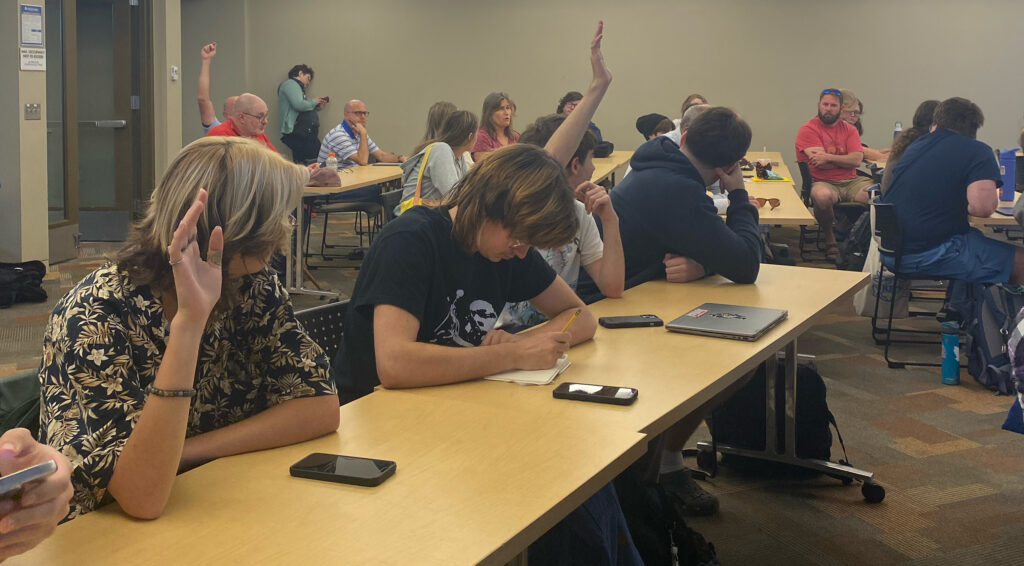
Students were concerned that with continued program cuts, student enrollment could drop and students would start to transfer.
Horowitz said this was something that did not happen with the Fall 2023 cuts, and that she worries about that too. “We have actually seen retention go up since 2023,” Horowitz said.
Another concern students have with the potential major discontinuation is if professors are issued a retrenchment notice and choose to leave early.
Horowitz stated that this is something they did not see with retrenchments regarding the 2023 cuts. “We haven’t seen people leave sooner than [expected],” she said. “If we had a faculty member that left and we needed to find coverage, we would find coverage for that.”
When it comes to Fredonia’s multimillion-dollar deficit, everything is on the table, according to Horowitz and Wayne Lynch, vice president for finance and administration.
At the Sept. 25 SGA General Assembly meeting, when students asked about potential faculty cuts, Horowitz stated, “Nothing is safe,” adding that this would include administrators.
During the open session on Sept. 26, Lynch went through slides regarding Fredonia’s deficit.
As of Sept. 26, Fredonia is in a $6,937,016 deficit.
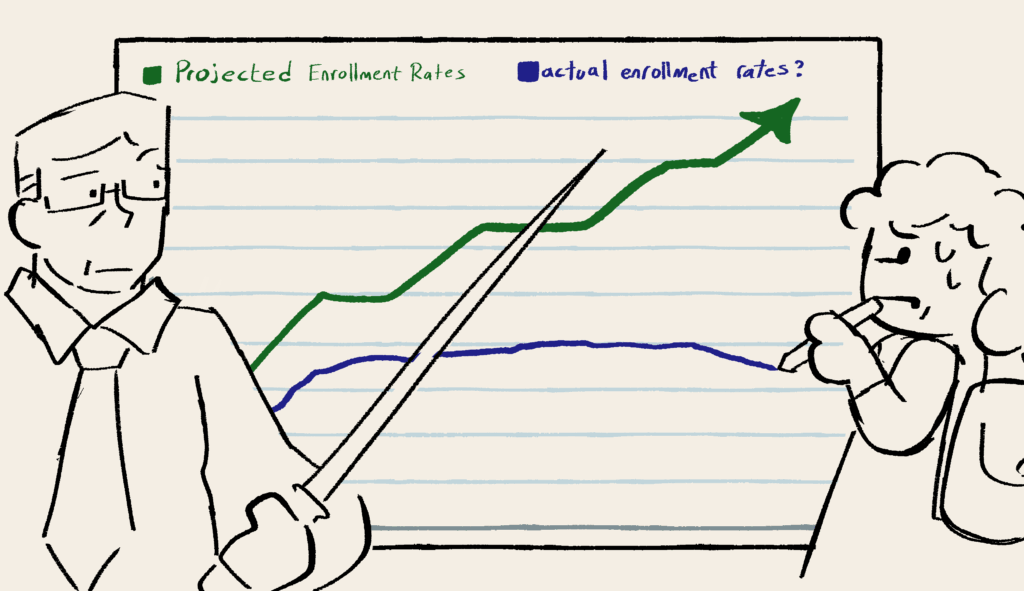
Lynch also generated a model to identify demand for a program as well as cost. This model, in conjunction with other criteria provided by faculty and students, will be used to develop a more detailed list of programs.
During the meeting, Horowitz reiterated that demand and cost are not the only things that go into a program potentially being cut.
The biggest thing causing this deficit is state revenue offset (administrative and academic accounts) which includes payroll, student services, utilities and more.
When discussing salaries, there were rumors going around campus that administrators would receive a pay raise.
When brought up, Horowitz explained that every year, SUNY allows the president of each university to give their managerial confidential employees (MCs) a raise of up to 3%.
During the Sept. 25 meeting, in discussion about whether MCs would receive a raise, Horowitz stated that she was unaware of any MCs receiving a raise.
Horowitz disputed the total pay listed on SeeThroughNY and told attendees her salary is $155,000. She added that she would not apologize for her salary as she spent many years working her way up to this position, often sacrificing along the way.
“I hear what you’re saying, and I understand the implication,” she responded to the question regarding her salary. “Would anyone in this room work for free? No. I won’t either.”
During Lynch and Horowitz’s open meeting on Sept. 25, when talking about the state revenue offset (administrative and academic accounts), the revenue was $31,323,735 and the total expenses being $46,770,209.
This brings the total deficit to $14,770,309 for that section.
This is what brings us to a total deficit just short of $7 million.
Since the almost $15 million deficit for “administrative and academic” includes utilities, questions were brought up about lights being on constantly in the Andrews complex (Igoe, Hendrix, Hemingway and Schulz Halls).
Lynch mentioned this was to keep the building structurally sound in case they ever need to use it again.
When the topic of how effective cutting programs would be on the $7 million deficit, students asked how effective the Fall 2023 cuts were. Horowitz mentioned that the projected savings from cutting those programs was $750,000.
When students questioned cutting more programs, Horowitz explained that the programs cut in 2023 had the lowest enrollment, some of which had two students enrolled in a program. This action was taken to attempt to prevent deactivation of programs with larger enrollment.
During these conversations Horowitz mentioned, “If we were a private school, we would have already gone out of business.”
After closing the meeting, Horowitz mentioned that President Stephen Kolison is taking the same steps he did during the Fall 2023 cuts by advocating for Fredonia to receive more money from SUNY.
Horowitz mentioned that these attempts have been successful.
In conclusion of the open sessions, Horowitz sent out a campuswide email informing faculty and students of everything so far and what to expect in the future.
The email reads, “Recommendations that I’ve heard from these meetings and will incorporate include:
- contributions from General Education offerings
- considering students enrolled in a minor attached to the program
- role of the major to groups or events on campus
- regular, bulleted communications to campus
- transparency through answering as much as possible as clearly as possible
Next week I anticipate the following will occur:
- meeting with Senate Exec to agree upon a timeline for program review
- sharing of the timeline with the campus community
- Academic Affairs Leadership Meeting and Consultation (Oct. 1)
- sharing of the list of criteria to be used for program review with the campus community.”
Horowitz again thanked the community and everyone who offered ideas on what should be considered when it comes to Fredonia’s deficit.
Currently, there is no other open session meeting scheduled, but Horowitz stated in her emails that if you were unable to attend, please send your ideas on program deactivation criteria to Provost@fredonia.edu.
The Leader will continue to provide updates as this story progresses.