MAISIE STRADER
Special to The Leader
Beethoven wrote the “Eroica Symphony No.3” and dedicated it to Napoleon.
The twist is, Beethoven ended up taking the dedication away after Napoleon declared himself emperor.
This moment is significant because it reflects the deep ties between musicians and political power during that era.
In Beethoven’s time, composers were often closely connected to royal courts in places like Austria and the Roman Empire.
Why does this matter? Artists were dictated to by the government.
Their work and muse were heavily influenced by those in power.
This very act is seen as a repeated pattern throughout history.
SUNY Fredonia choral teacher, Jessica Best, provided her thoughts on the topic.
“We can see how artists endured it, how people endured it, what the music they listened to sounded like at the time, and how they overcame those kinds of situations,” she said. “Music is always reflective of the people and the culture and the time.”
Best was born into a very musically talented family.
Her mother was her first piano teacher, her brother is an artist and her grandmother was part of the United Service Organizations (USO) during World War II, performing to support American troops.
“World War II [is] a big tie into why I’m doing this now because I feel like it’s our job as artists and people that have a talent to use that to help people,” Best said passionately.
Her grandma, whom she lovingly calls “Baba,” lived in Rochester with her sorority, working for a company called Sargent and Greenleaf during the time of the war.
Greenleaf put on large-scale productions that were connected to the USO, forming a branch that supported the war effort through entertainment.
Music has always been at the heart of her family — but it was the radio that pulled the strings, bringing it all together.
“Our grandparents are those that are not able to go out, or those that are ill, those that are on hospice, they have the radio on, and they they’re being healed through the music,” she says, “So I just think it’s a really big and important legacy, and that’s part of why it’s made me a new, good musician, but it’s also helped me as a musician, and it’s helped my whole family.”
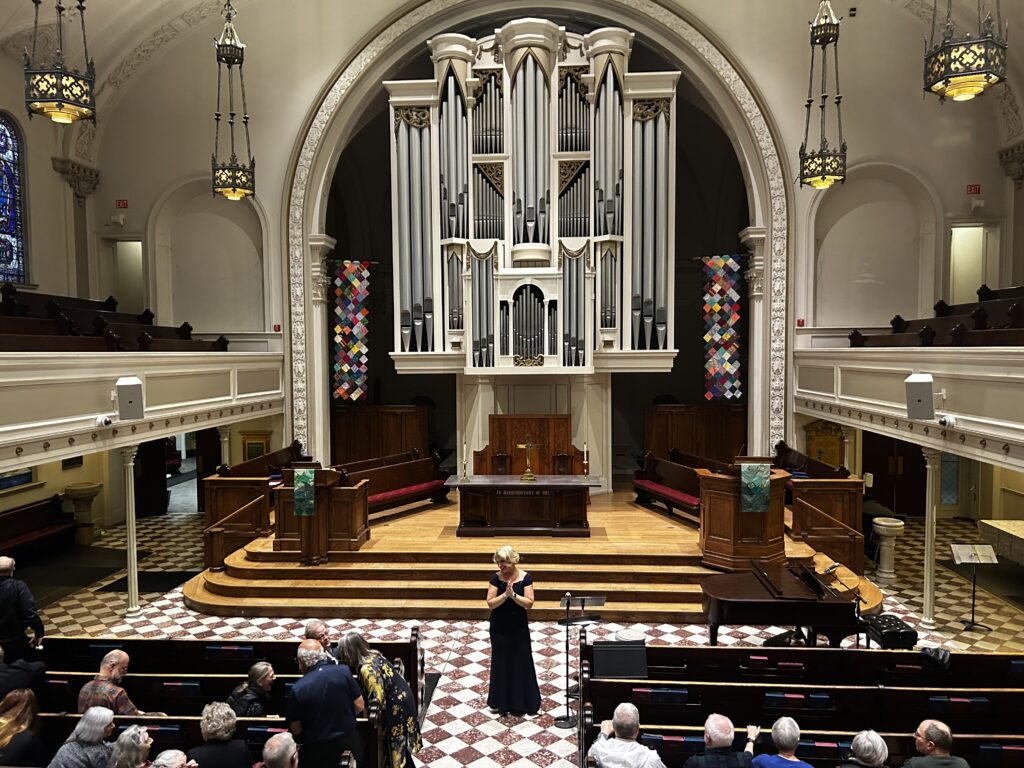
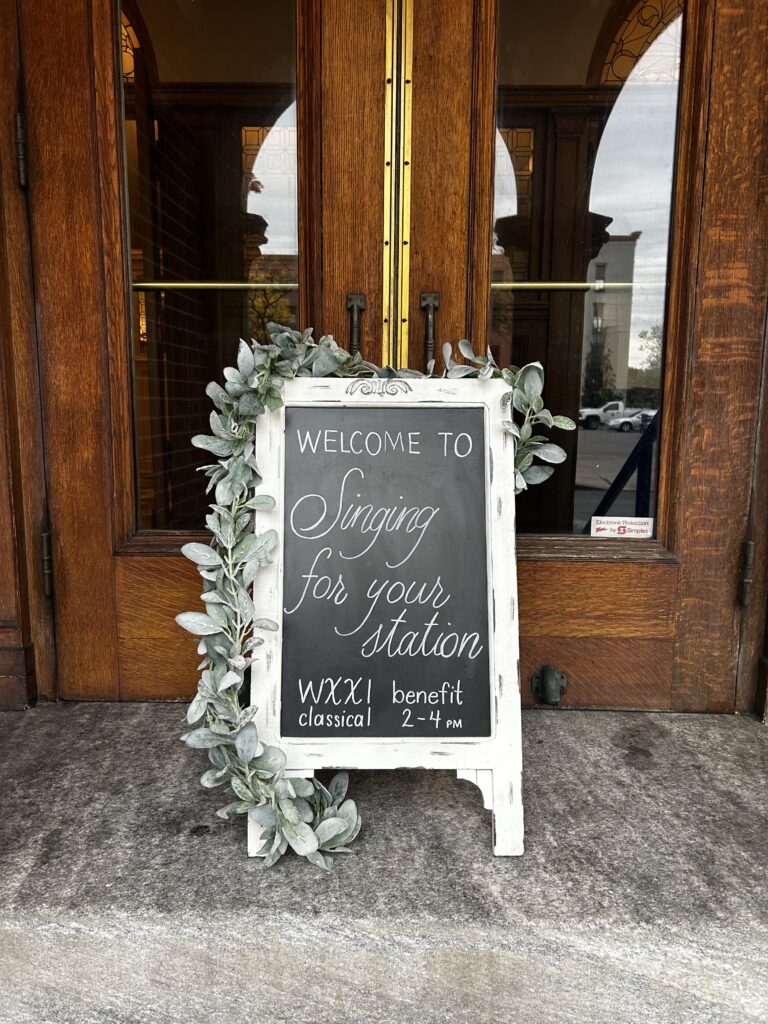
On Saturday, Oct. 11, Best performed at the Downtown Rochester United Presbyterian Church as part of an event titled “Singing for Your Station.”
The benefit concert, supporting WXXI Classical and paying tribute to Michael Lasser, featured nine singers and groups who performed from 2 to 4 p.m.
WXXI is a Rochester, N.Y. based, public AM radio station.
“I’m singing everything from Mozart to Gershwin, Irving, Berlin, Cole Porter, so it’s really fun what we call the Great American Songbook, these composers that are uniquely American, and a lot of musical theater in jazz in there as well,” she said.
Other performers will be Mark Daniels, George DeMott, Rob Goodling, Alan Jones, Cindy Miller, Abby Adair Reinhard, Lee Wright and members of First Inversion and the Downtown United Presbyterian Chancel Choir.
“I came up with the idea for the concert earlier in the summer when we knew that there were going to be a lot of cuts to the funding,” Best said. “I was watching a Zoom call with the head of WXXI radio, the family and I were watching the call, and I just thought, ‘I have to do something.’”
On July 24, 2025, President Donald Trump signed the Rescissions Act, which cut funds for the Corporation for Public Broadcasting (CPB).
According to NPR, the CPB lost $1.1 billion as a result of the decision.
Now, public broadcasting stations such as WXXI are funded almost entirely by private donations from listeners, viewers, foundations and corporations.
Even though “Singing for Your Station” was a generous event aimed at supporting a beloved community radio station, there was no set fundraising goal.
“If they [students] want to come and they can’t afford it, I want them to just come and sit there just to experience the music,” Best said. “Or if they can give $1, then they can give $1, but if people want to be more generous, or they want to donate, even the QR code to the website works now.”
In the spirit of open access to music and storytelling upholds the legacy of Michael Lasser, a beloved radio host on WXXI and a music historian.
Lasser was known for his show “Fascinatin’ Rhythm” (formerly “Anything Goes”).
“He sadly passed away this July. He was 89 years old,” Best said. “And so, I’ve had the pleasure of working with him in his, you know, late years, and learning a lot from him. So much of the concert is in tribute to him.”
In Best’s latest performances, her characters have expressed the same devotion to giving back, as much as she does, specifically in her role as Florence Foster Jenkins.
“She was completely tone deaf, and she just didn’t know. People kind of protected her, and yet she did all this stuff [singing] to raise money for people, and she loved it,” Best said. “She considered herself a true artist.”
In a time of uncertainty for public broadcasting, Best’s voice and commitment help keep the music alive for everyone.