
Alex Bucknam
Managing Editor
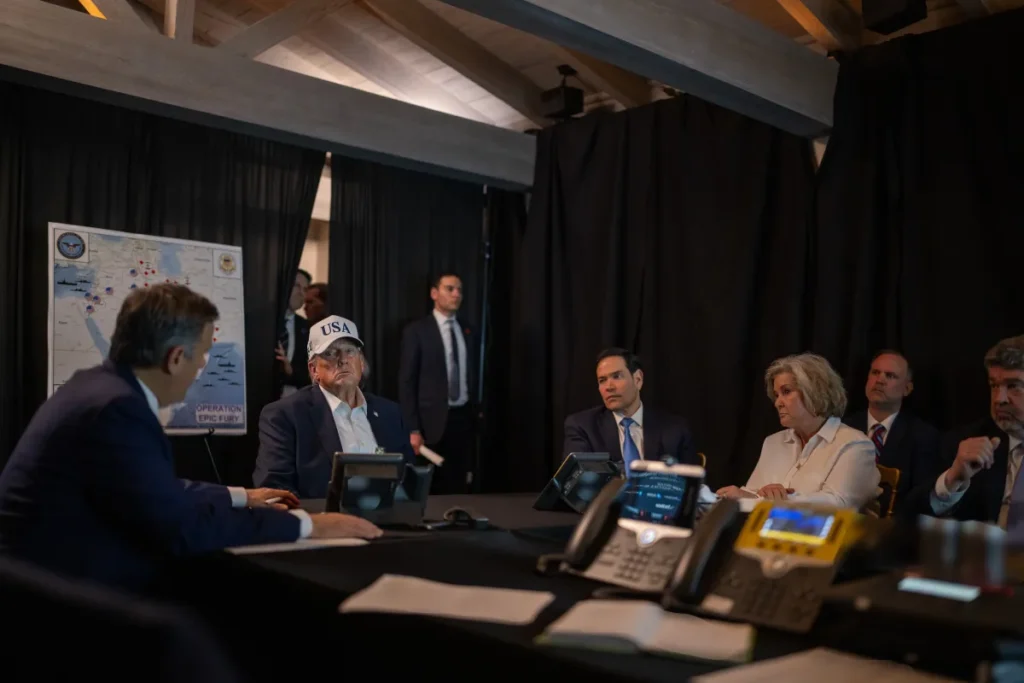
President Trump is briefed on Operation Epic Fury. Image courtesy of whitehouse.gov.
On Saturday, Feb. 28, the United States, alongside Israel, launched a major military strike against Iran. The ongoing operation was nicknamed Operation Epic Fury.
The attacks marked one of the most significant escalations between the two countries in recent years.
The first few strikes targeted Iran’s supreme leader, Ayatollah Ali Khamenei, as well as multiple Iranian air and naval bases.
U.S. officials said the targets were selected to disrupt Iran’s military command structure and its ability to coordinate a response.
The Central Intelligence Agency (CIA) claimed they were tracking Khamenei for months, coordinating their plan to attack based on his day-to-day schedule of when he would be above ground.
The CIA and Israeli intelligence moved up the attack when they discovered Khamenei was attending multiple high-level meetings with Iranian officials.
Later in the day, reports began to surface that the attacks killed Khamenei and other top Iranian officials. Iranian state media confirmed Khamenei’s death the following day.
The announcement sent shockwaves across the region and raised immediate questions about Iran’s leadership and political future.
It is still unclear who will permanently assume the role of the supreme leader.
Under Article 111 of the Iranian Constitution, a three-person interim council takes over the duties of the position if the role becomes vacant.
The council maintains authority until a new supreme leader is selected.
The interim council is made up of Iranian President Masoud Pezeshkian, Chief Justice Gholam-Hossein Mohseni-Eje’i and Guardian Council and Assembly of Experts member Alireza Arafi.
The group is responsible for temporarily overseeing the country’s political and military leadership. Iranian officials have not said how long the transition process may take.
Following the attack, President Donald Trump announced that the strikes would continue at full force. “They will continue until all of our objectives are achieved,” Trump said in a video posted to Truth Social.
The statement signaled that the operation was not intended to be a single round of strikes.
Trump later elaborated on what he meant by “our objectives.”
He said the goal of the operation is to weaken Iran’s military leadership and eliminate what he called threats to U.S. forces and allies in the region.
Trump said the operation is also meant to prevent Iran from launching further attacks against American bases and Israel, and for a regime change.
“We are targeting the systems and leadership responsible for aggression in the region,” Trump said. “Our objective is stability through strength and making sure Iran can no longer threaten American troops or our allies.”
Iran responded quickly to the attacks. Within hours, Iranian forces launched retaliatory strikes against United States military installations across the Middle East.
Several bases in Israel, Bahrain, Qatar, the United Arab Emirates and Kuwait were targeted.
Some of the strikes successfully reached their targets.
Military officials said air defense systems intercepted many incoming missiles, but several still made an impact.
During an attack that occurred at the port of Shuaiba in Kuwait, Iranian missiles struck a facility used by United States forces stationed in the area.
The attack killed six United States Army Reserve members.
Initial reports from U.S. Central Command said three service members had died.
As additional information was gathered and rescue operations continued, the number of confirmed deaths rose.
Officials said several additional service members were injured in the strike.
Trump announced the deaths in a video posted to Truth Social.
“As one nation, we grieve for the true American patriots who made the ultimate sacrifice for our nation,” Trump said.
The president added that the country will pray for the recovery of those wounded in the attack.
Trump also warned that the casualties may not be the last.
“And sadly, there likely will be more before it ends. That’s the way it is,” he said.
Military officials say the situation remains ongoing. Additional U.S. and Israeli strikes have reportedly continued against Iranian military infrastructure.
Some targets include missile launch sites, command centers and weapons storage facilities.
Pentagon officials said the operation is focused on limiting Iran’s ability to respond with further large-scale attacks.
“Our forces are continuing defensive and offensive operations as necessary,” a U.S. defense official stated.
For now, both sides appear to be preparing for continued confrontation.
Iranian leaders have vowed retaliation, while U.S. officials say operations will continue until military objectives are met.
“We will respond to every act of aggression,” Iranian Foreign Ministry spokesperson Esmaeil Baghaei said on state television.
As of now, the attacks between the United States, Israel and Iran are ongoing.
Air defense systems across the region remain on high alert, and additional military assets have been moved into position.
Officials say the coming days will likely determine whether the conflict expands further or begins to stabilize.
“This situation is still developing,” a U.S. defense official said. “Right now, the focus is protecting our troops and responding to threats as they emerge.”
The Leader will provide updates as they come.