
GRACELYN BEACHNER
Asst. Copy Editor & Social Media Manager
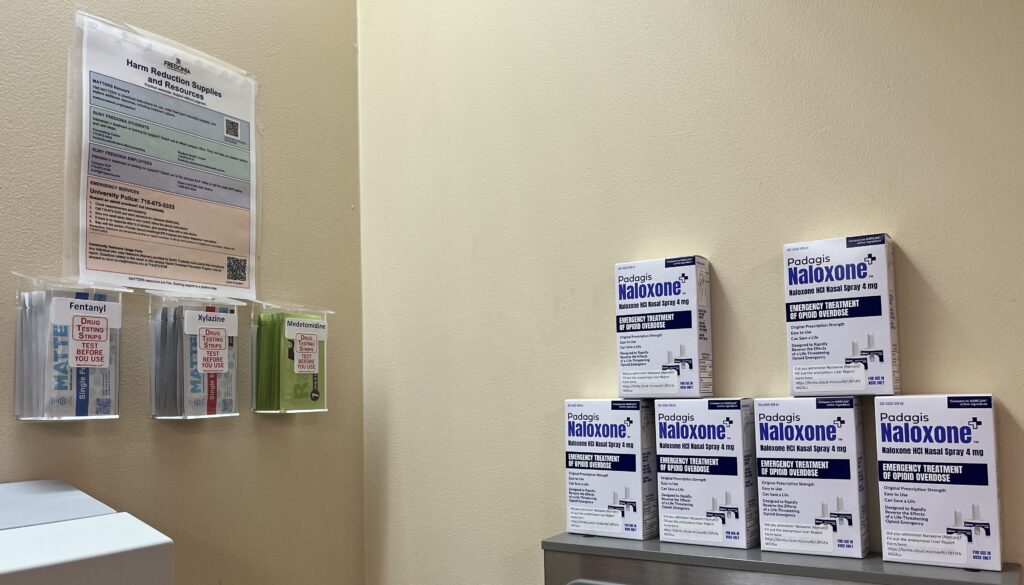
“Naloxone located in Gregory Hall, next to the Faculty Student Association Office.” Photo by: GRACELYN BEACHNER | Asst. Copy Editor & Social Media Manager
70,000 drug overdose-related deaths occurred in 2025, according to the United States Center for Disease Control. (CDC)
While it’s an alarming amount, the number has been decreasing since 2022.
According to the CDC drug-related death rates decreased alongside an increase in nationwide access to resources available to drug-users.
These resources include hotlines, rehabilitation and harm reduction, such as access to sterile needles and Narcan.
Harm reduction is a public health movement with the purpose of lessening the negative consequences of drug use without requiring complete sobriety.
According to the email, Narcan is a life-saving drug that reverses opioid overdose symptoms by blocking the opioid receptors in the brain.
In a campus wide email sent by the Finance and Administration Office, on behalf of Environmental Health and Safety and Sustainability on Oct. 9, they made campus aware that Narcan will now be available and completely anonymous in Gregory Hall.
According to the CDC symptoms of an opioid overdose include unconsciousness, unresponsiveness, vomiting, inability to speak, bluish/grayish skin, irregular heart rhythm and loss of motor function.
Narcan is also safe even if opioids are not ultimately the cause of the symptoms.
The CDC wants people to know It’s important to note that the opioid effects may last longer than the Narcan administered; Narcan only lasts 60-90 minutes. You can re-administer Narcan if symptoms of overdose return after that period.
Along with Narcan, drug-testing strips will also now always be available in Gregory Hall. These testing strips can test for Fentanyl, medetomidine and xylazine.
This is important because according to the CDC combining these drugs can cause a lethal overdose, even in small amounts.
In a CDC report made in 2026, there has been an increase in cases of illicit drugs being laced with these opioids has occurred.
Testing strips allow users to test for unintended opioids, “Illicit drugs can contain unexpected substances, including potent opioids or other drugs that may not be visible, smelled or otherwise detectable.” According to the Oct. 9 email.
Fredonia wants the usage of these materials to be reported using an anonymous form also in Gregory Hall.
These forms are used for inventory purposes and require no identification.
Questions can be directed to sarah.laurie@fredonia.edu, Director of Environmental Health, Safety & Sustainability.