
ALEXANDER FISHER
Special to The Leader
Colleges are communities. Or at least, they used to be.
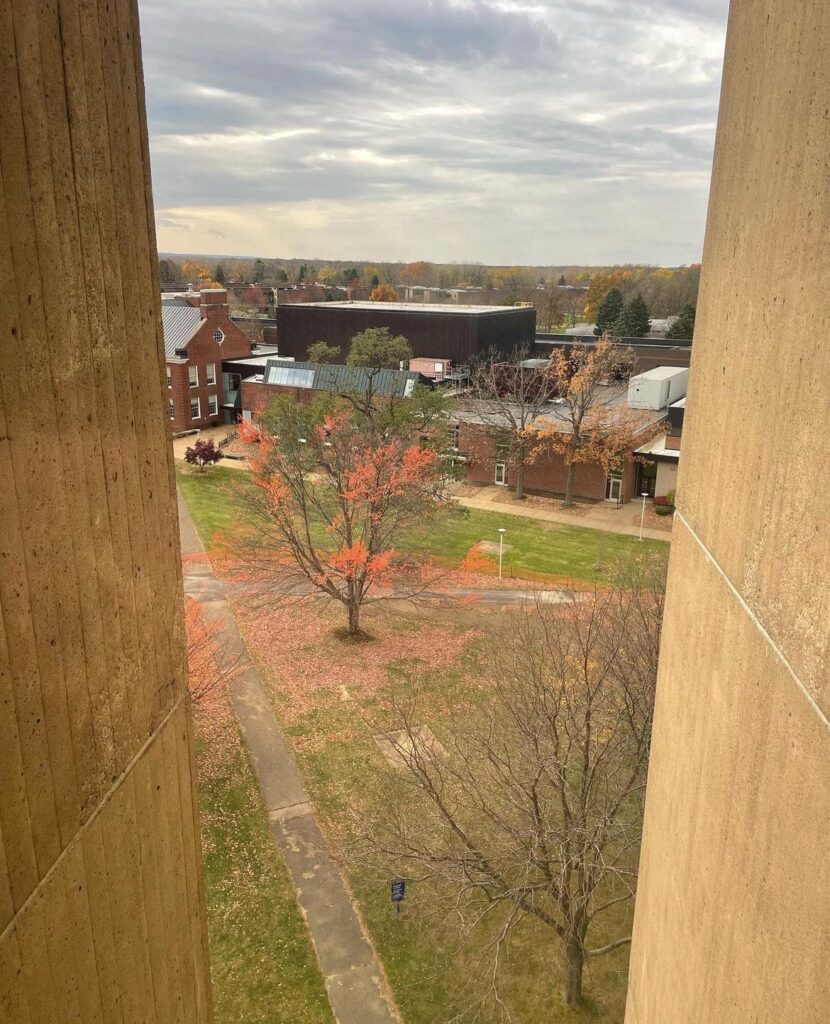
Standing on the seventh floor of Maytum Hall, I have a bird’s eye view of Fredonia’s campus, from the music complex to the arts building, the dining hall and the dorms.
It’s midday, and despite the bright sun and vibrant autumn leaves dotting the landscape, the campus is strikingly empty. Those few people that I do see below me look down on their phones, headphones or earbuds, all walking…
Alone.
I’m here for an interview — to meet face-to-face, with Dr. Tracy Stenger, interim director of
Student Affairs at Fredonia. She began her work at Fredonia in 1998, working in the Lograsso Hall Counseling Center, and later served as executive director of wellness and support before taking her current position as head of Student Affairs.
When I first came to Fredonia, the university was in the midst of dealing with the COVID-19 pandemic. Masks were required, and desks were socially distanced. I had occasional Zoom classes, but as a spring 2021 high school graduate, I missed out on much of the university’s initial shutdown response. Dr. Stenger filled me in.
After the campus adopted hybrid in-person learning in the fall of 2020, the lasting emotional effects of COVID-19 lockdowns started to show up in the campus community. “We had just hoped people would pick up where they left off,” said Dr. Stenger. “We’re not seeing that.”
According to Stenger, the university conducted qualitative studies among select groups of students when the campus returned to in-person learning. She said the research showed students were struggling with how to engage when they went to on-campus events. “There’s a desire for connection, but [they’re] struggling with the skills of how to build that,” said Stenger.
Why aren’t social skills something that comes naturally to us anymore?
In a spring 2021 Harvard poll, we found part of the answer. It revealed that 61% of young adults experienced ‘serious loneliness.’ Two years later, a global Meta-Gallup poll conducted in fall 2023 found that nearly a quarter of
young adults worldwide — 27% — felt ‘very lonely’ or ‘fairly lonely.’
While the pandemic and its lockdowns and social distancing procedures may be a thing of the past, a quarter of young people still feel this way today. The psychological effects are ever-present.
I spoke to my friend and former research partner Anne Smith, who was a freshman at Fredonia in
the fall of 2020. Now in her senior year, Smith recounts her earliest experiences as an undergraduate student.
“For me, I feel like socialization was such a low priority that it just didn’t happen at all,” Smith said. “The expectation was, sort of by society—and I think the school followed it—was no hanging out. No talking to each other, don’t gather.”
But were the COVID-19 limitations really the start of our loneliness epidemic? Or were the masks, the lockdowns, the social distancing only an accelerant?
A 2021 ‘Journal of Adolescence’ article by a multidisciplinary group of professors found that young people were already getting lonelier before the world shut down. “Nearly twice as many adolescents in 2018 scored high in loneliness than in 2000, with much of the increase occurring after 2012,” states the article. Although these figures significantly increased, the authors note that, “A majority of students did not report high levels of loneliness.”
From the 2010’s onward, socialization was irreversibly changed, thanks to social media. Interaction between people is no longer mandatory to survive. We’re living in the era of technology, texting and interconnectedness. While the internet has generated a platform for new, productive, fruitful connections to be made between two equally
interested parties, sometimes that isn’t always the case. The internet facilitates friendships, job opportunities and global experiences, but it also facilitates something else: isolation.
“We’re able to be around people on our devices, but it doesn’t give us the same experience,” said Dr. Stenger. Over the past decade, as our lives have transformed to be increasingly more online, we’ve seen an increase in communication being over the internet rather than face-to-face. When the world switched from one dimension (real life) to two dimensions (real life AND the internet), our brains were forced into a situation where we needed to adapt.
In many ways, we didn’t.
“Parasocial relationship” is a term used by medical professionals to describe an increasingly common experience among Americans today. According to a June 2022 article penned by Dr. Cynthia A. Hoffner of Georgia State University, parasocial relationships can be defined as “nonreciprocal socio-emotional connections with media figures such as celebrities or influencers.” Examples of parasocial relationships are those where people place uneven values in their relationship with each other, be those public figures, Twitch streamers or YouTubers.
Often, these faux-connections develop toward content creators with whom the individual spends a lot of their time engaging with. This is one of the effects of isolation.
Parasocial relationships may develop when an individual perceives themselves as lacking something, a real-life space for vulnerability or to share interests and passions for example, or simply out of increased interest in the party involved.
Social media has only increased the propensity for parasocial relationships to develop. Seeing a favorite actor or content creator’s regular social media posts, leaving comments and sharing the content, and perhaps even receiving a ‘like’ or a reply from the celebrity, can give satisfaction to viewers, and create a perceived sense of connection. For the commenter, this may be a moment they remember forever; for the celebrity, it’s likely an insignificant moment in their day.
But parasocial relationships have dangerous potential. As noted in an article from the University of Texas, “Parasocial relationships are common and (mostly) harmless, so long as someone doesn’t start believing their own fantasy.”
It’s important to be aware of boundaries in approaching these types of situations. If the viewer isn’t able to distinguish between their perceived relationship or desired relationship and reality, more serious issues arise.
“You’re with them; you start to believe you have a relationship with them that is not real,” says Dr. Stenger. “[Streamers] have shared something about themselves, giving live access to their lives.”
With content such as livestreams, where viewers can directly ‘chat’ and interact with creators in real time, there is a danger of developing a parasocial bond so strong that it only further contributes to isolation and poor mental health.
A July 2022 article of The New York Times, penned by Kellen Browning and Kashmir Hill, detailed one such instance, in which popular Twitch streamer Kaitlyn Siragusa (known as Amouranth online) was stalked and harassed by a man who sold all of his possessions in his home country to travel to see her.
The man believed there was a two-sided, mutual relationship between him and the streamer. Amouranth has millions of followers from across the globe. She did not know him or who he was at all. Just like actors don’t know every person who watches their movies, content creators cannot be expected to entertain relationships with all of their viewers.
Siragusa, interviewed for the same Times article, said, “In livestreams, they see into your home, into your bedroom, and it feels very personal to them… I think that is what contributes to a lot of the stalking — they feel like they know you.”
Dr. Carol Laurent Jarzyna of the Illinois-based organization PsychedUp, wrote in a 2020 research study, “Parasocial relationships can have positive effects, too. While parasocial interaction should not replace real relationships, the behavior can supplement them in filling social needs and decreasing loneliness.”
Spending time in a parasocial relationship can be constructive for the ‘parasocial’ party. If a person is feeling a sense of solidarity with an online figure or their community, they may actually experience positive health benefits from that experience.
Parasocial relationships can be shared between people. Two ‘viewers’ may have forms of fan-viewer relationship over a shared subject matter. In fact, fans may develop a relationship of their own based on their shared love of this person. There can be great power and solidarity in sharing that common interest, even with someone across the globe, because it helps some people to feel less alone.
Social media applications such as Instagram, Twitter and Discord make it possible for people to gather en masse with fellow fans or viewers, creating massive global communities with unprecedented social opportunity.
On the negative side, being in a shared space with like-minded individuals can lead to group-think, for instance. Just as with our tangible world, where homogeneity breeds fear or distrust of ‘the other,’ the same can happen within these pocketed online groups. We see this with online communities where people are shunned for criticizing a favorite content creator.
“It’s a whole lot easier to disagree with somebody or say something hurtful [or] negative … when it’s anonymous,” said Dr. Stenger. “Something I would never say to your face, I would be much more comfortable doing in an online environment.”
A 2023 biopic by filmmaker Mike Clum on disgraced Youtuber Steven Williams (also known as Boogie2988) sheds some light on one such situation. Williams, nearly 50, lives an isolated life with a diluted worldview despite his initial success. He experienced a meteoric rise to fandom in the early 2010’s for his skit comedy and video game playthroughs on YouTube. But since then, Williams has gained quite a negative reputation online — in part because of his 2021 arrest, allegations of abuse toward his ex-wife, and his broad and almost shameless self-deprecating, pessimistic rhetoric and worldview.
So what happened to Steven Williams? Eventually, he started being more open about his own experiences — speaking on deep personal struggles. But at some point along the way, it stopped being simply a catharsis for him and became more of an attention vortex; Williams complained about his life, and begged his viewers for money (in one instance, asking them to ‘dig in deep’ so he could buy a Tesla).
Williams has become isolated from the world because of the controversy around him and his own choices. He sees himself as ‘above’ working ‘some job’ because of his online clout. Throughout the documentary, Williams’ narcissism is on full display. He refuses to get a job.
“I’m not gonna walk into some job,” he says, “When I have 4 million subscribers on YouTube.”
Unfortunately, Williams is blinded by the parasocial relationship he’s developed with his fanbase. He belittles himself online, and gets attention — good or bad — for it. And while he’s a particular flavor of self-aggrandizing, he’s nevertheless far from alone in that he seems inextricably attached to the online attention afforded by his parasocial relationship with his ‘fans.’
Dr. Stenger nodded as I told her Steven Williams’ story. “I have four million subscribers, but are
those friends?” she says. “People who are in these very public positions… are very isolated and lonely.”
Parasocial relationships can be especially dangerous when the person they’re directed towards abuse them to his or her advantage. While we’ve only discussed online communities, there can be resonating effects when these parasocial communities enter the real world, leaping from our screens and manifesting in the political reality of our country.
The Make America Great Again movement, jump-started by then-presidential candidate Donald J. Trump in 2015, took the nation by storm. Brimming with populist rhetoric and fantasies of a glorified past, the movement appealed to Americans feeling dissatisfied with the state of the nation.
Similarly to online personalities, former President Trump’s supporters follow him religiously: purchasing his merchandise, repeating his talking points, and generally thinking about and talking about him way more than any average person would discuss a politician. Like streamers and content creators, Trump thrives off of his base; his rallies are far less about informing potential policy decisions and far more about hitting ‘all the points’ of his followings’ most crazed beliefs.
They have their own call-and-response language. He knows the right things to say to get them riled up, he knows what they like to hear, and, more importantly, what they don’t want to hear. Parasocial relationships, when experienced en masse and on such a widespread scale, create a downward spiral of post-truth that threatens to suck down our government and institutions with it.
Because of their unflinching and unwavering support, followers can find themselves isolated from family and friends. They become embroiled in this world of make-believe that their favorite ‘creator’ has built for them, and any challenge to this, anything that threatens to undo the relationship they perceive themselves to have with the celebrity, is seen as a threat. They may respond to these perceived threats violently or aggressively, burning bridges in the process.
And thus, they find themselves alone.
We can’t let it come to this. We can’t let people fall into these pits of isolation, of total despair where they cut themselves off from reality. Surely, there must be ways to combat this, to stop it before it even begins. So what can we do about it?
“It’s hard, it’s a challenge. It’s important for students — we know that their sense of connection
and belonging has a big impact on whether they’re going to stay in higher education,” says Dr. Stenger. “When students are not experiencing a sense of belonging,…a sense of connection,… those are the antidotes to loneliness. [The college is] trying to be a lot more intentional about how we facilitate it.”
This year, Fredonia has been working to build opportunities for student connection back up from their post-COVID levels. The Fredonia Counseling Center has implemented a ‘THRIVE’ Campaign.
Additionally, the University has introduced an initiative through the ‘Project Connect’ program, with the goal of fostering more interpersonal relationships between students on the campus. Dr. Stenger explained, “[It’s a] research-based, data-informed program to help students connect.”
The pilot of Fredonia’s Project Connect was this fall, she says, and they hope to expand the program going into the Spring 2024 semester. It has a goal of building up the social skills in students who are too anxious or don’t know how to handle social situations. And, best of all, she says, it was successful in the test run.
I thank Dr. Stenger for her time. We’ll be in touch, I tell her, and we shake hands goodbye. I step outside of the office and return to the hallway. As I wait for my elevator to come up to the seventh floor, I look down at the university sprawling out below me, at the people rushing to and fro across the sidewalk.
Change can start on the University level. But it also starts on a personal level, too. A wave and a smile to a stranger. An effort to connect with someone from a shared interest. Including others in our plans and knowing the signs of loneliness. During the pandemic, we didn’t have to put as much effort into our social relationships, and it changed us. But now, it’s time to make a conscious effort to connect as human beings across the world again.